



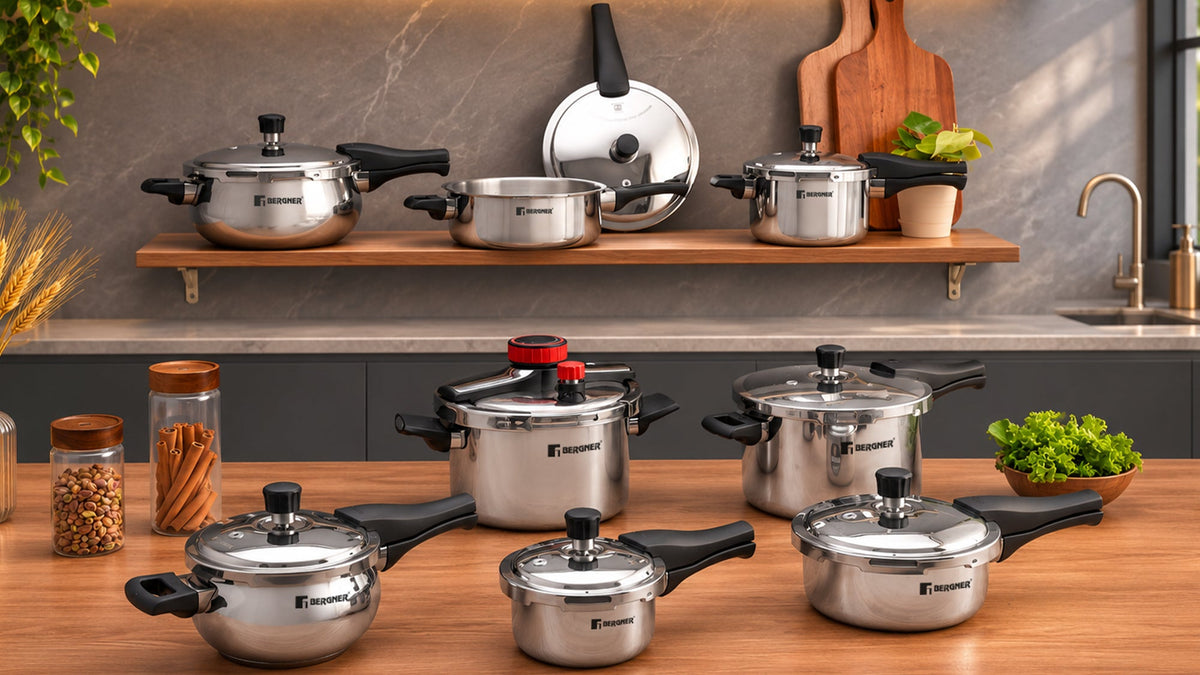
Your dal is on the stove, the tomato-onion masala is ready for the next batch, and you wonder whether the old aluminum cooker is still the right choice. The stainless steel pressure cooker has become a regular in Indian kitchens, but the higher price makes many families pause.
The doubts are fair. Is it safe? Does food stick? Is it worth the money? This guide answers each one briefly.
Is a Stainless Steel Pressure Cooker Safe? What to Check
Safety depends on two things: the steel and the pressure system. Food-grade stainless steel stays stable with acidic dishes like tomato gravies and tamarind-based sambar. Researchers at Sweden’s KTH Royal Institute of Technology tested how much metal seven grades of stainless steel released into food. All seven released less than the limits that Council of Europe guidelines set for food-contact materials.
The pressure system matters just as much, so look for:
- A gasket release system that lets extra steam escape if the vent is blocked
- A safety valve that opens before pressure crosses a safe limit
- A lid lock that stays shut while the cooker is under pressure
- ISI certification and a handle that stays cool to hold
What Makes a Tri-Ply Steel Pressure Cooker Different?
A tri-ply steel pressure cooker has a base made of three bonded layers: food-grade stainless steel inside, an aluminium core in the middle, and magnetic stainless steel outside. The core spreads heat across the base, so masala and dal cook without burning in one corner.
Stainless Steel vs Aluminium Pressure Cooker: Which One Is Better?
In a stainless steel vs aluminium pressure cooker comparison, the deciding factor is usually what you cook most. Aluminium reacts with acid, and much of everyday Indian cooking is acidic: tomato gravies, sambar, rasam and pickles. Germany’s Federal Institute for Risk Assessment (BfR) found that uncoated aluminium trays released aluminium into acidic test foods such as tomato puree. Those were trays, not cookers, but the same chemistry applies inside a bare aluminium cooker. The table below shows how the two compare.
| Feature | Tri-Ply Stainless Steel | Aluminium |
| Heat spread | Even, from the aluminium core | Quick, but can have hot spots |
| Dents and stains | Resists both well | Marks more easily |
| Weight | Heavier | Lighter |
| Cost | Higher | Lower |
Which Is the Best Stainless Steel Pressure Cooker Size?
The best stainless steel pressure cooker is the one that fits your household. A stainless steel pressure cooker 5 litre handles a typical day’s dal and rice in one go. Choose three litres for one or two people, and six litres or more for large families or batch cooking. Before buying, check for:
- Lid style: an inner lid for fewer splatters, or an outer lid for easier cleaning
- Spare gaskets and service support
- A warranty you can register
How Does a Bergner Tri-Ply Pressure Cooker Fit Your Kitchen?
Bergner makes tri-ply pressure cookers that work on induction and gas. Two options cover different household sizes:
- Smaller households: the Argent Tri-Ply 18/8 Stainless Steel Inner Lid 5L Pressure Cooker has a rivetless design for easy cleaning, a 2.5 mm body, ISI-certified safety and a five-year warranty.
- Larger families: the Argent Elements Triply Stainless Steel 5.5 L Outer Lid Pressure Cooker has a safety gasket release system and an easy-lock lid, and it suits batch cooking.
Browse the tri-ply pressure cooker range to compare sizes.
Read More: Why to choose a Bergner Triply Pressure Cooker over other brands?
Is a Stainless Steel Pressure Cooker Worth It?
A stainless steel pressure cooker is worth buying if you cook every day, mix acidic and mild dishes, and want one cooker that serves for years. Match the size to your household and check the certification before you buy.
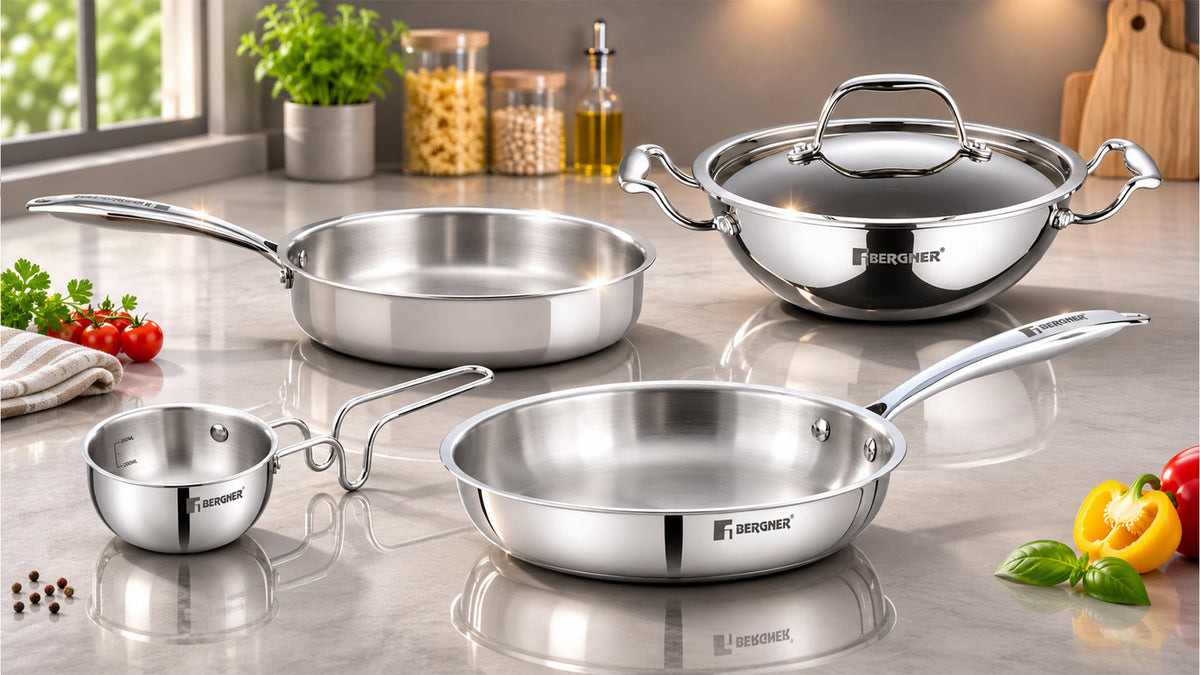
Looking for cookware that pairs with your pressure cooker? Explore the full tri-ply collection for kadais, tope sets and more. Happy cooking!
FAQs
Q. Is a tri-ply pressure cooker safe for daily use?
A. Yes. A tri-ply pressure cooker is safe for daily use with a few habits. Fill it only up to two-thirds, or half for dal and rice, which foam and expand. Clear the vent before each use, and wash the lid and valve after cooking.
Q. Is a stainless steel pressure cooker better than aluminium?
A. Yes, for daily cooking of mixed dishes, a stainless steel pressure cooker is better. Stainless steel is non-reactive, more durable, and better for acidic foods like sambar, tomato curry, and chole.
Q. Does food stick in a stainless steel pressure cooker?
A. A stainless steel pressure cooker can stick, mainly when the base is too hot or too dry. Warm the empty base on a medium flame for a minute, add oil or ghee, and keep the flame medium while you sauté. Add enough water for rice and khichdi.
Q. Can a tri-ply pressure cooker be used on induction and gas?
A. Yes, if the outer layer is magnetic steel. Look for an “induction base” label, or check that a fridge magnet sticks firmly to the bottom. The aluminium core then spreads heat evenly, whether it comes from a gas flame or an induction coil.
Q. Why are tri-ply pressure cookers more expensive?
A. Tri-ply pressure cookers cost more because they use more material and a more involved process: three bonded layers, food-grade steel, an induction-ready base, and sturdier lids and handles. The body is built to last, so the cost is spread over many years.
Q. How long does a stainless steel pressure cooker last?
A. A stainless steel pressure cooker body can last many years with regular care. Replace the gasket every one to two years, clean the vent after each use, and let the cooker cool before washing.

Leave a comment
All comments are moderated before being published.
This site is protected by hCaptcha and the hCaptcha Privacy Policy and Terms of Service apply.